You Borrowed the Look. Not the Struggle.
On EJ Johnson, Borrowed Femininity, and the Patriarchy That Came Dressed to the Party
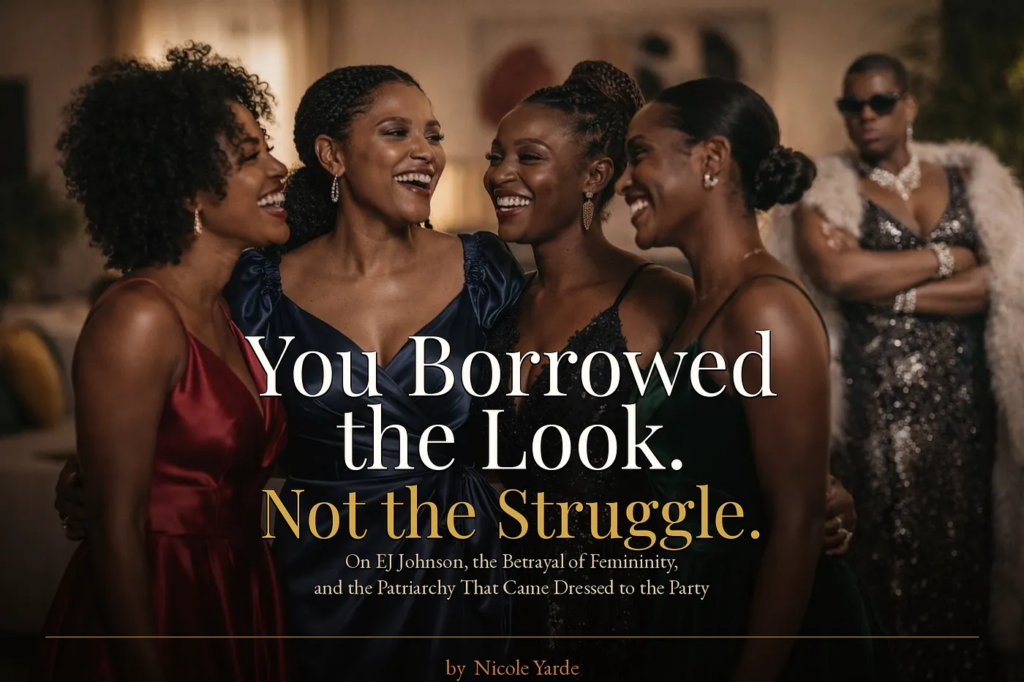
I do not like asparagus. That does not make me anti-vegetable. Write that down, because it is the whole framework for everything that follows.
I am a Black woman with questions about EJ Johnson. That makes me a Black woman paying attention. And when I watched EJ Johnson’s March 2026 interview with Carlos King on Reality with the King, I felt that quiet, familiar friction, the kind you recognize before you can explain. Just enough to make you pause. The kind that tells you something is off, even when everyone else is laughing.
That feeling has a language.
It is the specific kind of exhaustion that comes when the people borrowing from you start competing with you. When access becomes entitlement, and the guest starts critiquing the house. That is where solidarity breaks down. And right now, we need to talk about that.
So, EJ Johnson.
The Interview That Started the Conversation
On March 10, 2026, EJ Johnson, child of NBA legend Magic Johnson, sat down with media personality Carlos King on his “Reality with the King” podcast for what was billed as a rare, candid interview. And candid it was. EJ, who now uses they/she pronouns and describes themselves as “a deeply feminine being,” spoke openly about their gender journey, their refusal to be boxed in, and their evolution from “Magic Johnson’s son” to, as they put it, “Miss Thing.”
There is much in that interview worth celebrating. Watching anyone claim their truth with that level of unapology is powerful. Full stop.
But then EJ said this:
“I never saw anything wrong with anything that I did, like even when I was a kid, and they were like ‘You can’t wear a skirt,’ and I was like, ‘Why not?’ My inner being was like, ‘There’s nothing wrong with it, especially if I look cuter than any girl does, like, what’s the problem?’”
And just like that, we had a problem.
Yes, it could be read as playful confidence. Shade culture has its own grammar, and maybe that is all this was. But playfulness does not neutralize the framework it arrives in. The joke is still structured around being better than the women. The self-worth is still calibrated against theirs. And when you are standing at the intersection of inherited male privilege and a $600 million family fortune, that framing carries weight that “just playing” does not dissolve.
And the “cuter than any girl” remark was not an isolated moment. Later in the same conversation, EJ explained that their entire dating life is structured around competing with straight women, for the same men, in the same rooms. One comment could be shade. Two reveals a framework.
The logic embedded in that sentence is the issue. The logic that says: I can wear the skirt because I wear it better. The logic that not only steps into womanhood but also elbows women aside on the way in.
That is competition, and it has a name: patriarchy.
The Visitor’s Pass
Here is something I love about Eminem. Truly love. Yes, I am defending Eminem in an essay about Black women’s liberation. Stay with me.
Eminem did not just flirt with hip-hop culture. He dove in headfirst. He studied it, mastered it, earned the co-sign of Dr. Dre, stacked up number ones, made the movie, lived the ethos. By any measurable standard, Eminem belongs in the conversation about the greatest rappers alive. And he knows it.
But Eminem has never used the N-word.
Not once — not in a song, not in a cypher, not in a private tape that leaked. Because as embedded as he is in that world, as beloved and decorated and accepted as he has become, he understands something essential. He holds a visitor’s pass. His embedment in Black culture, however deep or real, has limits. And the mark of his respect for that culture is his willingness to honor the limit.
That is what EJ has not yet arrived at.
You can be feminine. You can be fabulous. You can wear every dress, walk every runway, and fully inhabit the feminine expression that is clearly and genuinely yours. A visitor’s pass still applies. Because identifying as a woman, even deeply and authentically, does not come with the lived history. The years of being treated as one. The accumulation of being diminished, dismissed, underpaid, stereotyped, and told to shrink since the day you arrived on this earth in a female body.
The visitor’s pass is an invitation to humility. That is the whole offer.
What Eminem understood about racial boundaries, EJ has not yet grasped about gendered ones.
Black Women Are Not Competing With You
Let us be clear about something the world still gets wrong about Black women.
We have been saddled for generations with the image of the “competitive Black woman.” The crabs-in-a-barrel lie. The idea that we are always pulling each other down, always in each other’s way, always too loud, too much, too territorial to build anything together. It is a stereotype that has been weaponized against us in workplaces, in media, in courtrooms, and in the cultural imagination.
And while that lie was being told about us, we were building.
This is not new. Black women have been constructing spaces of mutual refuge since the 19th-century literary salons, gatherings where women like Maria Stewart and Frances Ellen Watkins Harper read, debated, and sharpened one another before the world was ready to hear them. Dorothy Height built the National Council of Negro Women into a force that outlasted every institution that tried to ignore it. The tradition runs unbroken from there to now. Book clubs. Writing collectives. Golf clubs. Chess circles. Supper clubs. Mentorship networks. Business incubators. Online communities. Black women have spent generations quietly and not-so-quietly constructing spaces of joy, intellect, sisterhood, motherhood, and survival because the world was not going to build those things for us. We created our own table because we kept being turned away from everyone else’s.
These spaces were never built on competition. They run on communion. They are a living, breathing protest against every force that told us we were too much or not enough or wrong to exist with confidence in our own skin.
So when EJ sits across from Carlos King and frames their femininity through the lens of being cuter, better, more fashionable than “the girls,” that lands somewhere specific. That language, from that position, from someone who walked into this world carrying the social conditioning of a man raised with generational privilege, is patriarchy, rebranded in femininity.
Patriarchy Has No Dress Code
Patriarchy will wear whatever it needs to wear to stay in power.
This is where it gets complicated, and it is worth sitting with the complication. Patriarchy belongs to the conditioning, and the conditioning does not care what you are wearing.
EJ grew up in that water. We all did.
The difference is that the women in the room have been fighting against that conditioning for their entire lives, often within the very communities that should have protected them. Black women have had to unlearn the idea that we are each other’s competition. We have had to actively choose solidarity over the scarcity mindset the world handed us.
When someone who has recently claimed femininity as their identity walks into the space and immediately frames their existence through competition with women, the water is showing. The queerness was never in question. Neither was the femininity. The patriarchy is the water. And never stopped to ask what they were drinking.
What the Visitor’s Pass Actually Offers
What would it look like if someone in EJ’s position used the platform differently?
EJ has what most people will never have: Magic Johnson’s name, a decade of public visibility, and a cultural moment that is finally, slowly making space for gender-fluid, femme-presenting people to exist without being erased.
And if EJ is listening —
There is an extraordinary opportunity here to use all of that to be an ally.
Because the women whose wardrobe you are borrowing, whose aesthetic you are inhabiting, whose cultural space you are moving through, have been fighting for your right to do exactly what you are doing. Black queer people, Black women, Black trans women specifically, have paid, and are still paying, enormous prices to make this cultural moment possible. They did not compete their way to it. They built, they bled, and they buried their dead to get here.
And this is worth naming clearly, because precision matters: EJ is gender-fluid. That is a distinct experience from being a trans woman, and this essay is not collapsing the two. Trans women, particularly Black trans women, face a level of violence, erasure, and institutional hostility that is in a category of its own. The critique here has nothing to do with policing who gets to be feminine or who gets to claim womanhood. It is about the framework through which someone narrates their entry. The femininity is welcome. The competition is the problem.
The visitor’s pass is a reminder of what is owed to the house. You are not just representing yourself. You are shaping how others will understand what you represent.
You do not have to be cuter than the girls. You don’t need to compete with the women. Or position your femininity as superior to theirs to justify its existence. Just be the thing. Inhabit it fully and without apology, and trust that presence is more powerful than performance. And in the moments when you have a microphone, and someone like Carlos King is listening, use it to lift the people who opened the door.
This is not theoretical. There are Black men who have walked through femininity’s door and understood exactly what that meant. André Leon Talley spent decades in the most rarefied rooms in fashion — rooms built by women, run on women’s labor, alive with women’s vision — and he moved through every one of them with reverence. He celebrated the women around him. He made them more visible. He understood that his presence in those spaces was a gift, and he treated it accordingly. Billy Porter puts on a gown and walks a red carpet and talks about femininity as something worth honoring, worth protecting. He carries it like it costs something. Because he knows it did.
But right now, EJ is not following it. Right now, EJ is sitting across from Carlos King, telling the world they are cuter than the girls. And that is not the blueprint. That is the old pattern in a new outfit.
The Macro Truth
This is bigger than EJ. It always was.
Someone crosses into a marginalized community. They are welcomed or tolerated. And then they begin to critique and compete with the people in that community rather than stand beside them. We see it when people claim to love Black culture but dismiss Black people. We see it when men who benefit from feminist progress use the language of feminism to recenter themselves. The details change. The pattern does not.
Belonging is revealed through alignment. Never through dominance.
The invitation was always open. Plenty of people have walked through it with grace, built community, and made the whole house bigger. The question has always been: when you enter, do you build, or do you compete?
The space was never the issue.
History does not celebrate the ones who competed for space. It remembers the ones who expanded it.

You may also like

Letter to Mother Over in Away

Perfect Strangers: Echoes of a Black Suburban Youth